
The Vertical World: Why Wall Diving is Every Diver’s Dream
For many, the first few dives of a scuba career are spent on gentle slopes and sandy bottoms. You follow the contour of the reef, keeping a comfortable eye on the seafloor below. But eventually, every diver reaches a moment where the “bottom” disappears.
You swim over a ledge, and suddenly, the earth falls away. To your left is a vibrant, living wall of coral; to your right is an endless, indigo abyss.
This is wall diving. It is the closest a human can come to the sensation of true flight. In this vertical world, the rules of perspective change, the diversity of life explodes, and the mental state of the diver shifts from “exploration” to a deep, meditative “Zen.”
The Physics of Inner Space
Wall diving is a masterclass in buoyancy. On a flat reef, you have a physical reference point—the sand—to help you judge your depth. On a wall, you have only your computer and your senses.
The physics of a vertical drop-off create a unique sensory experience. Because there is no visible bottom to provide a sense of scale, you enter a state often described as “Inner Space.” Without the visual clutter of a seafloor, your brain stops processing “down” as a destination and starts processing “out” as an infinite horizon.
1. The Challenge of Neutral Buoyancy
Maintaining a perfect hover is never more critical than on a wall. Because the wall often drops to hundreds of meters, you cannot “land” if you become over-weighted. You must rely entirely on your lung volume and BCD control. For an experienced diver, this is where the sport becomes an art form. You aren’t just swimming; you are suspended in a three-dimensional liquid universe, effortlessly drifting along a vertical tapestry of life.
2. The Light Spectrum
As you move vertically, the world changes color. In the first ten meters, the wall is a riot of reds, oranges, and yellows. As you descend past twenty, the red light is absorbed by the water, and the wall takes on a moodier, more mysterious hue of deep purples and electric blues. Observing this shifting spectrum as you glide downward is one of the most visually rewarding aspects of the vertical world.
Two Worlds in One: The Biodiversity of the Edge
A coral wall is essentially an “underwater skyscraper.” It acts as a massive vertical reef that intercepts different currents at different depths. This creates a “two-for-one” diving experience that you simply can’t find on a flat reef.
On the Wall: The Macro Kingdom
If you turn your nose toward the wall, you’ll find a miniature world of incredible complexity. The vertical surface is a labyrinth of crevices, ledges, and overhangs.
-
Gorgonian Fans: Large sea fans thrive on walls because they can stretch out into the current to catch passing nutrients.
-
The “Small Stuff”: Look into the cracks to find nudibranchs, pygmy seahorses, and porcelain crabs. The wall provides a protected sanctuary for the reef’s most delicate residents.
In the Blue: The Pelagic Patrol
If you turn your back to the wall and look out into the abyss, the view changes entirely. The “blue” is where the predators live. Because walls often sit at the edge of deep-water channels, they are the primary hunting grounds for pelagic species. It is common to see reef sharks, tuna, and massive schools of jacks patrolling the open water just a few meters away from your fins.
The Bohol Perspective: The Zen of Balicasag
While there are many walls in the world, few can match the pristine, vertical perfection of the Balicasag Marine Sanctuary in Bohol, Philippines.
Bohol is a region defined by its unique limestone geology, and this extends far beneath the waves. The islands here are often topped with lush greenery but sit on massive underwater pillars of ancient coral.
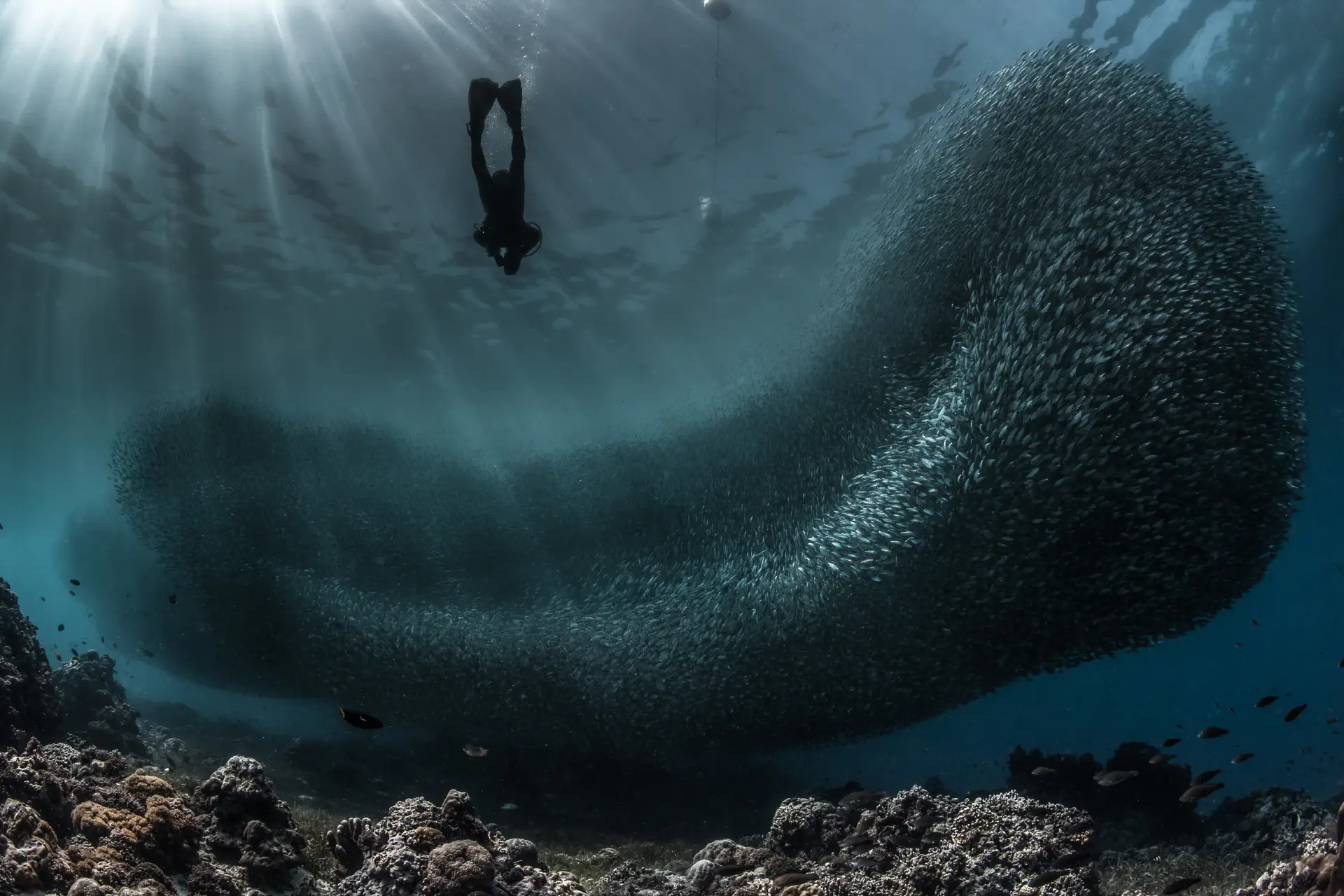 The “Tornado” at Black Forest
At sites like Black Forest or Rudy’s Rock in Balicasag, the wall doesn’t just slope; it is a sheer, vertical drop that feels like an underwater cathedral. As you drift along these walls, it is common to find yourself in the middle of a “fish tornado.” Thousands of Big-Eye Trevally (Jacks) often form a massive, silver swirling cylinder that moves as a single organism along the wall.
Total Zen Silence
What makes Bohol’s wall diving truly special is the tranquility. Because the sanctuary is protected and fishing is strictly regulated, the reefs are remarkably quiet and healthy. There is a specific type of “Zen” that occurs when you are drifting at 20 meters, perfectly neutral, with a wall of neon-colored soft corals on one side and a group of twenty sea turtles peacefully grazing on the other. It is a place where you can finally “turn off” the noise of the world and simply exist in the moment.
Tips for Mastering the Wall
To truly enjoy the vertical world, you need to adjust your technique.
-
Stay Close, But Not Too Close: Stay near enough to the wall to see the macro life, but be careful not to touch the coral or get caught in an overhang if there is a surge.
-
Check Your Depth Constantly: Without a bottom to look at, it’s easy to slip five or ten meters deeper than you intended. Your dive computer is your best friend on a wall dive.
-
Master the “Frog Kick”: On a wall, traditional flutter kicks can kick up silt or accidentally strike the reef. A frog kick keeps your profile streamlined and your fins away from the coral.
-
Look Up: Don’t forget to look toward the surface. The silhouette of turtles or rays against the sunbeams is one of the most iconic sights in wall diving.
Why Every Diver Needs the Abyss
Wall diving reminds us that the ocean is not a two-dimensional map, but a three-dimensional frontier. It challenges our skills, rewards our curiosity, and provides a sense of peace that is hard to find anywhere else.
Whether you are exploring the deep, mysterious walls of the Red Sea or the sun-drenched, turtle-filled precipices of Bohol, the vertical world is where the true magic of scuba diving happens. It’s time to stop walking on the bottom and start flying at the edge of the world.